

- This event has passed.
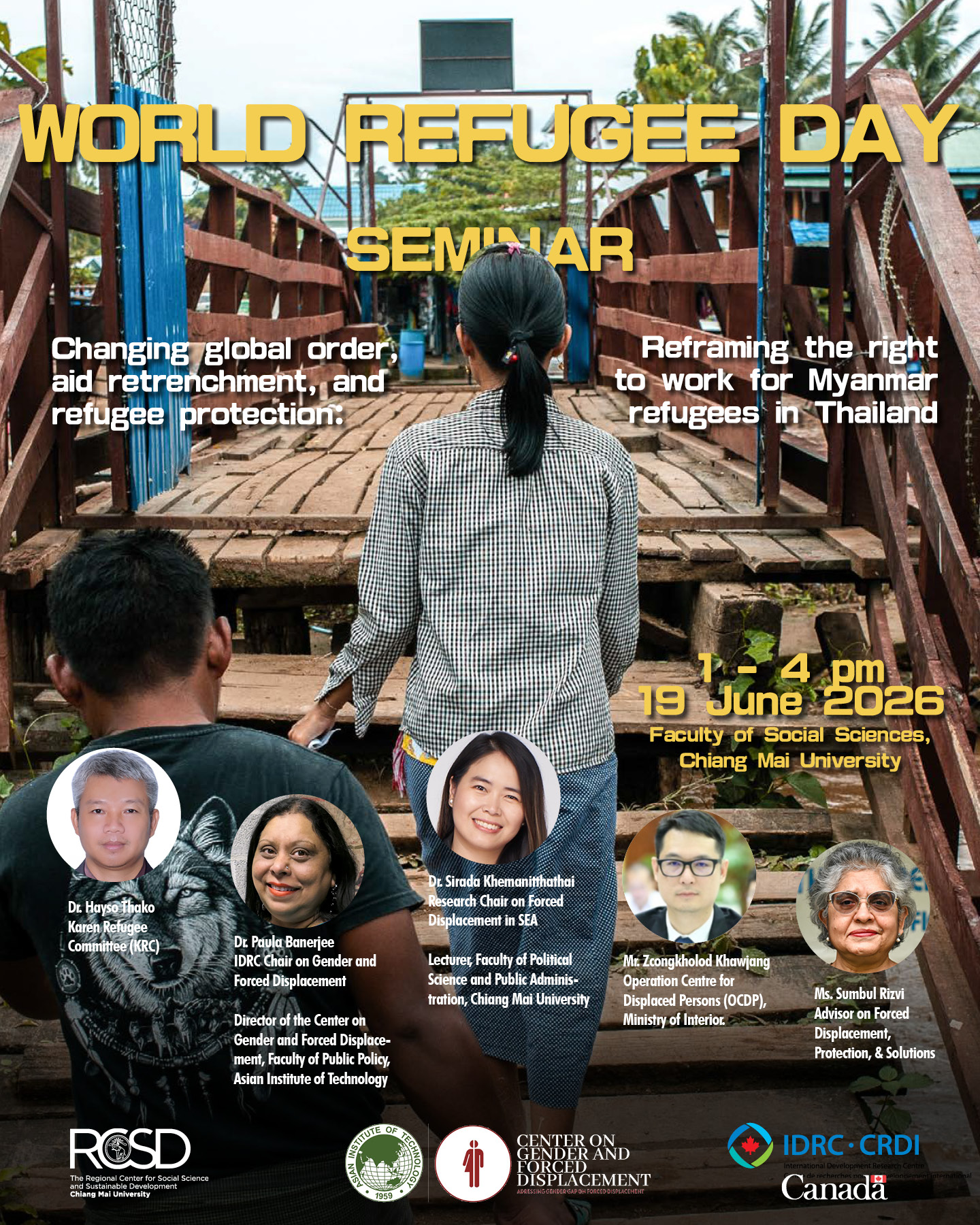
World Refugee Day 2026 Seminar
Changing Global Order, Aid Retrenchment, and Refugee Protection: Reframing the Right to Work for Myanmar Refugees in Thailand
13:00–16:00, 19 June 2026
Venue: 4F Meeting Room, Operations Building, Faculty of Social Sciences, Chiang Mai University, Chiang Mai (or register to join online)
Register to participate here.
Hosted by the Regional Center for Social Science and Sustainable Development (RCSD), Faculty of Social Sciences, Chiang Mai University, in collaboration with the Center on Gender and Forced Displacement, Asian Institute of Technology (AIT) and made possible with the support of the International Development Research Centre (IDRC/CDRI) of Canada.
World Refugee Day 2026 provides an important opportunity to examine how changing global political and economic conditions are reshaping refugee protection. As humanitarian funding declines and international support becomes increasingly uncertain, responsibility for refugee protection is being transferred more heavily to host countries, while refugees themselves are often expected to achieve self-reliance under challenging and precarious conditions. These developments raise important questions about responsibility-sharing, refugee rights, and the future of protection in the Global South.
This seminar brings together academics, practitioners, policymakers, and civil society actors to discuss the implications of aid retrenchment, changing protection regimes, and regional political uncertainty for refugee-hosting countries and displaced populations. Focusing on the case of Myanmar refugees in Thailand, the seminar uses the right to work as an entry point for broader discussions on refugee protection, self-reliance, encampment, and regional approaches to displacement in Southeast Asia.
The right to work occupies a central place in refugee protection. Beyond its status as a legal entitlement under international refugee law, access to decent and secure employment is closely linked to income security, dignity, psychosocial well-being, and reduced dependence on humanitarian assistance. At the same time, access to work is shaped not only by legal frameworks but also by political, economic, and administrative factors operating at both national and local levels.
These issues are particularly relevant in Thailand, where refugee governance has long been characterized by legal ambiguity, camp-based containment policies, and differentiated treatment of refugees and migrant workers from Myanmar. Experiences from other refugee-hosting contexts also demonstrate that formal access to employment does not necessarily translate into meaningful livelihood opportunities. Refugees may remain confined to informal, insecure, or highly restricted forms of work, especially where regulations are unstable, employment sectors are limited, or broader protection concerns remain unresolved.
Against this backdrop, the seminar asks not only whether work opportunities can be expanded for Myanmar refugees in Thailand, but also under what legal, political, and ethical conditions employment can contribute to meaningful protection and long-term well-being.
The discussion will be guided by three key questions:
* How is global aid retrenchment transforming protection responsibilities in refugee-hosting states?
* How can the right to work be understood as both a protection issue and a political-economic question?
* What are the implications for Myanmar refugees in Thailand at a time of protracted displacement, constrained labor market opportunities, and uncertain policy futures?
By bringing together diverse perspectives, the seminar aims to foster a grounded and critical dialogue that is academically rigorous, policy-relevant, and responsive to the lived realities of displacement. It seeks to contribute to wider discussions on dignity, autonomy, state interests, and regional responsibility-sharing in an era of profound change for refugee protection.
Participants will include Dr. Sirada Khemanitthathai, Research Chair on Forced Displacement in Southeast Asia and Lecturer, Faculty of Political Science and Public Administration, Chiang Mai University; Dr. Paula Banerjee, IDRC Chair on Gender and Forced Displacement and Director of the Center on Gender and Forced Displacement, Faculty of Public Policy, Asian Institute of Technology; Mr. Zcongklod Khawjang, Operation Centre for Displaced Persons (OCDP), Ministry of Interior; Ms. Sumbul Rizvi, Advisor on Forced Displacement, Protection, & Solutions; and Dr. Hayso Thako, Karen Refugee Committee (KRC)