
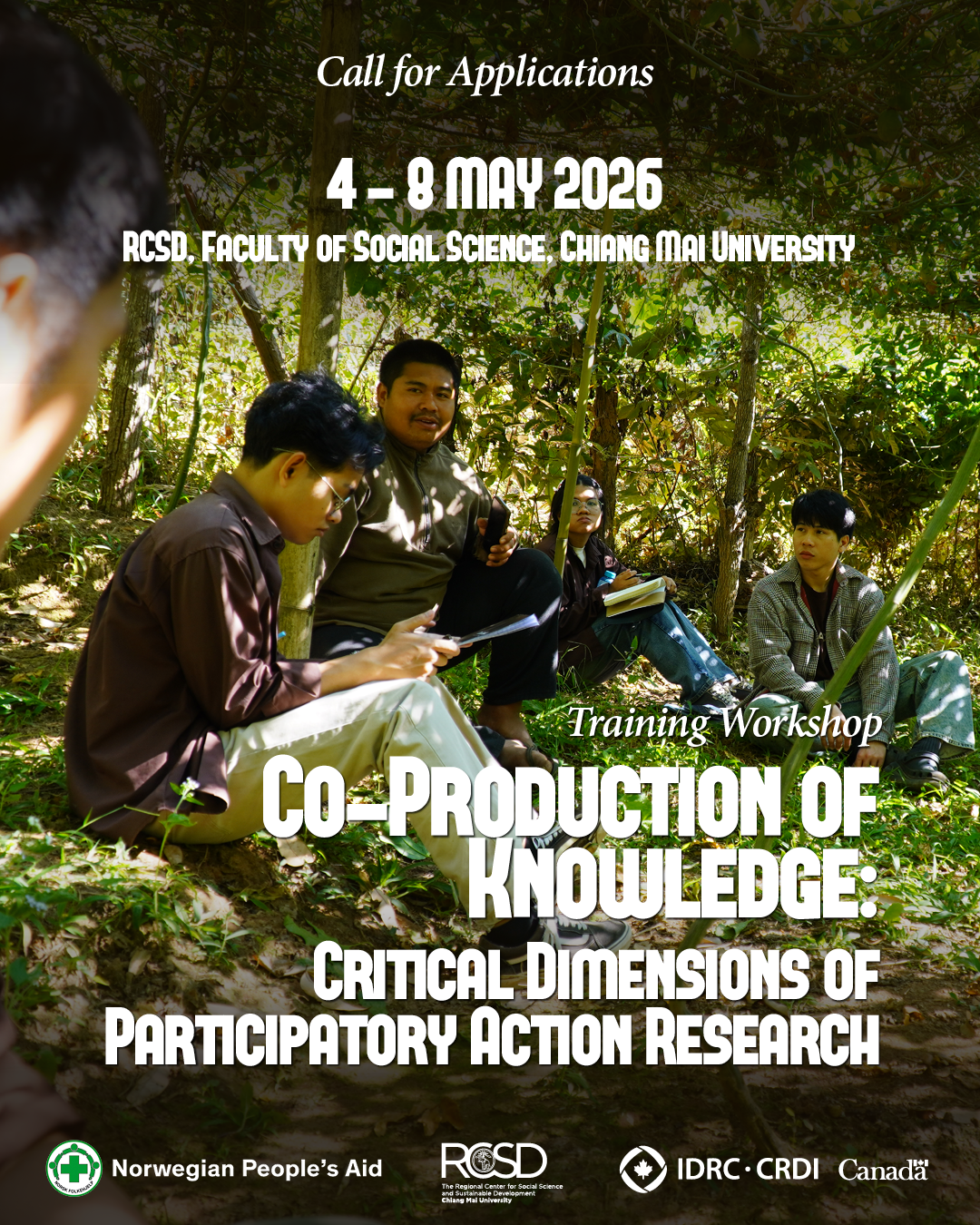
The Regional Center for Social Science and Sustainable Development (RCSD), Faculty of Social Sciences, Chiang Mai University, with the support of the International Development Research Centre (IDRC) and Norwegian People’s Aid (NPA) invites graduate students, early-career scholars, journalists, and development practitioners to apply for a 5-day training workshop titled: “ Co-Production of Knowledge: Critical Dimensions of Participatory Action Research.”
The workshop will take 4–8 May 2026 at Chiang Mai University.
This workshop explores how participatory action research (PAR) works in practice, and how the idea of co-producing knowledge is being shaped and redefined in today’s regional context. It brings together young and emerging scholars who are interested in working with communities and engaging with real-world social and environmental issues.
Participants will learn from both theory and practice, using Thai Baan research as a key case study to understand how communities can generate their own knowledge and challenge dominant research frameworks. The workshop will introduce practical tools and methods for conducting participatory research, grounded in lived experiences from the field.
The program focuses on collaboration between academics, local communities, and civil society. It pays particular attention to contexts such as environmental conflicts, agrarian change, large-scale development projects, and the climate crisis. issues that are deeply affecting communities in Thailand, Myanmar, and border regions across Southeast Asia.
Background and Rationale
Across Southeast Asia, many communities are facing rapid environmental and social transformations. These changes arise from multiple factors, including climate change, large-scale development projects, state conservation policies, and extractive industries. Such processes do not only transform natural landscapes but also profoundly affect people’s livelihoods, reshape social relationships, and often shrink civic space and opportunities for meaningful participation in decision-making processes.
However, within research processes and policy-making, the voices and knowledge of local communities are frequently treated merely as supporting data, or reduced to being “objects of study,” rather than being recognized as knowledge producers with the capacity to interpret and explain their own realities.
In many areas across the Mekong region, communities have developed bottom-up research approaches to challenge these unequal power relations in knowledge production. A prominent example is Thai Baan Research, a community-based research approach initiated and carried out by local communities in collaboration with civil society organizations. This process enables communities to document their ecological knowledge, livelihoods, and the impacts of development projects affecting their territories.
Such approaches are not only academic tools. They also function as processes that enable communities to build confidence in collecting data, conducting analysis, and interpreting their own realities. The knowledge produced through these processes is therefore not merely technical information; it is knowledge deeply embedded in lived experiences, collective memory, and everyday practices.
Local knowledge thus becomes an important source of power for negotiation and social struggle. It can support communities in protecting their resources, questioning development projects, and challenging the authority of state-led or expert-driven knowledge systems.
This workshop invites participants to explore fundamental questions related to the Politics of Knowledge, such as:
- How is knowledge produced, and by whom?
- Whose knowledge is recognized within policy-making processes?
- How can collaborations between researchers, practitioners, and communities contribute to more just and inclusive forms of environmental governance?
The workshop also engages with key debates in contemporary scholarship, including:
- Political Ecology
- Participatory Research
- Decolonizing Knowledge
The program emphasizes co-production of knowledge as a process that requires dialogue, trust, and collaborative learning among scholars, practitioners, journalists, and communities.
By bringing together participants from across Southeast Asia, the workshop aims to create a space for:
- critical reflection on the role of knowledge in society
- the exchange of field-based experiences
- the exploration of new approaches that bridge academic knowledge with the power of community-based knowledge.
Ultimately, knowledge is not merely a tool for explaining the world. It is also a force that shapes the future of communities and their struggles for environmental justice.
Workshop Components
The workshop consists of three main components:
- Lectures and Thematic Discussions
Key topics include:
-Co-production of knowledge and participatory research
– Thai Baan Research and community knowledge systems
– Political ecology and environmental justice
– Power, expertise, and hierarchies of knowledge
– Research methodologies for working with communities
– Ethics in community-engaged research
These sessions will combine lectures with interactive discussions among participants. - Case Studies and Experience Sharing
Participants will share experiences from their research or professional work, including topics such as:
– Environmental conflicts
– Development projects and agrarian transformation
– Local and indigenous knowledge systems
– Community-engaged research
Through group activities and dialogue, participants will explore how the co-production of knowledge can contribute to:
– Research practices
– Policy engagement
– Social movements - Field Visit
The workshop will include a field visit. Participants will have the opportunity to meet and learn directly from community members about:
– Community-based environmental knowledge
– Participatory research processes
– Local resource management practices.
The field visit will allow participants to reflect on how community-engaged research can be practiced in real-world contexts
Expected output
A concise critical analysis of an existing study (your own work, or of others) that examines power imbalances in knowledge production, highlighting where and how local voices and knowledge systems can be centered or more meaningfully included.
Eligibility
Applications are open to participants from Southeast Asian countries, with preference to those already in Thailand, with special consideration for a limited number of exceptional candidates outside Thailand.
Applicants may include:
- Graduate students
- Early-career scholars or lecturers
- Journalists and media practitioners
- Civil society and development practitioners
- Applicants should demonstrate an interest in topics such as:
- Environmental justice
- Community-engaged research
- Participatory methodologies
- Knowledge production for social change
Financial Support
Selected participants will receive full or partial financial support, including:
- Travel costs
- Accommodation
- Meals
- Workshop materials
Application Requirements
Applicants can begin the process here. You can submit the following documents online through the link:
- Personal information
- Statement of Interest (maximum 500 words)
- explain your research or professional interests and their relevance to the workshop theme
- Short CV (maximum 2 pages)
- Abstract of a research project or initiative (maximum 500 words) related to one or more of the following themes:
- Community-engaged research
- Environmental justice
- Participatory knowledge production / Politics of Knowledge
Important Dates
Application Deadline: 10 April 2026
Notification of Results: 15 April 2026
Workshop Dates: 4–8 May 2026
Contact
Email: office@rcsd-cmu.com