
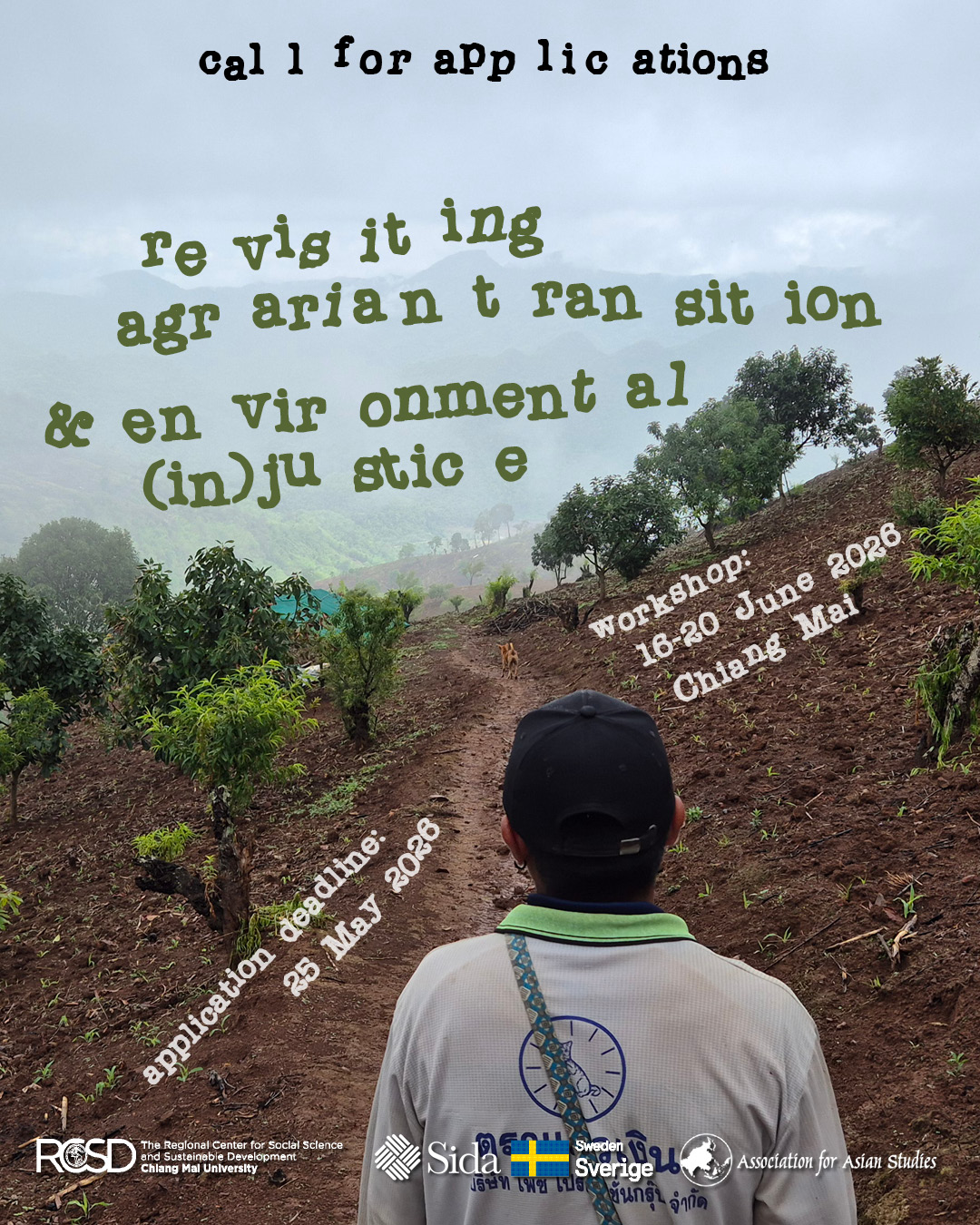
The Regional Center for Social Science and Sustainable Development (RCSD), Faculty of Social Sciences, Chiang Mai University, is pleased to invite early-career researchers and PhD and MA graduates from Southeast Asia to apply for a five-day research capacity-building workshop on “Revisiting Agrarian Transition & Environmental (In)justice” from 16-20 June 2026 at the Faculty of Social Sciences, Chiang Mai University.
The agrarian transition is, in a nutshell, the changes taking place in agrarian societies—mostly in developing countries—under a forced transformation into industrial capitalism. Previous research in the field has largely focused on power relations, particularly the role of the state and markets in reshaping access to land and natural resources. This relationship is evident in phenomena such as plantation expansion, labor and capital migration, and resource extraction. Agrarian transformation has, without a doubt, fundamentally reshaped socio-ecological relations, creating new forms of inclusion and exclusion. This is where it becomes clear that the agrarian transition is deeply connected to the intensification of climate change challenges, especially environmental injustice. Different groups experience unequal participation in decision-making and bear unequal consequences of both policies and environmental impacts across national, regional, or even inter-regional levels, reflecting the complex nature of contemporary agrarian transitions.
However, while mainstream perspectives have revealed the dynamics and complexities of these processes, they have had at least two significant limitations. First, they have been based on political power relations, viewing the struggle between Big and Small, thus bypassing or overlooking intra-level conflicts within the Small, such as land relations arising from everyday practices of land exclusion among kin or co-village neighbors. Second, most mainstream examinations of the agrarian transition have completely skipped the analysis of relations of production, thus failing to see exploitation between smallholders and labor, and how different forms of employment affect the production of the same product in different ways, which in turn impact the environment as well as social and power dynamics in different ways and to varying degrees.
This workshop will bring together a select group of 8–12 participants from Southeast Asia to investigate the agrarian transition and its links to environmental (in)justice, with a special focus on the two often-overlooked aspects discussed above. Participants will engage with key concepts and case studies, conduct a one-day mini-fieldwork, and present new experimental explanations—potentially opening up further questions and perspectives on the evolving relationships between capitalism, society, agrarian transition, and environmental justice.
This workshop is part of the “Cultivating the Humanities & Social Sciences & Supporting Under-Represented Scholars of Asia” project in collaboration with the Association of Asian Studies (AAS), with support from the Swedish International Development Cooperation Agency (SIDA).
Workshop structure
The workshop consists of two main parts: a series of lecture-discussion sessions during the first three days, and experiments connecting concepts to real-world phenomena through mini-field work during the last two days.
Expected outcome
- Participants will be able to produce short essays, which may be developed into future research or articles, approximately 1,500 to 2,500 words in length.
- Some participants may be selected to participate in a journal publication writeshop later in the year.
Eligibility
- Recently graduated students, preferably Ph.D, MA or MPhil, early-career scholars, independent researchers, and practitioners from Southeast Asia (especially Cambodia, Laos, Myanmar, Thailand, and Vietnam).
- Ongoing research or in the process of forming research ideas with preliminary field data.
- Able to be engaged throughout the five-day program and is committed to contributing to the output of the workshop. (Around 1,500-2,500 words of writing reflecting your application of the concepts in your research/other proposed output)
Support and costs
Selected participants will receive full or partial support (travel, accommodation, meals, and workshop materials).
How to apply
Please fill in the online application form here with following details
- Personal details & and CV
- A description of your research or project focus, including the current stage of the research/project (preliminary, ongoing, or completed), its relevance to the workshop themes, your expected contributions to the workshop, and—where applicable—plans for further developing and disseminating the outputs after the workshop.
Important dates
- Application deadline: 26 May 2026
- Notification of selection: 31 May 2026
- Workshop dates: 16-20 June 2026