
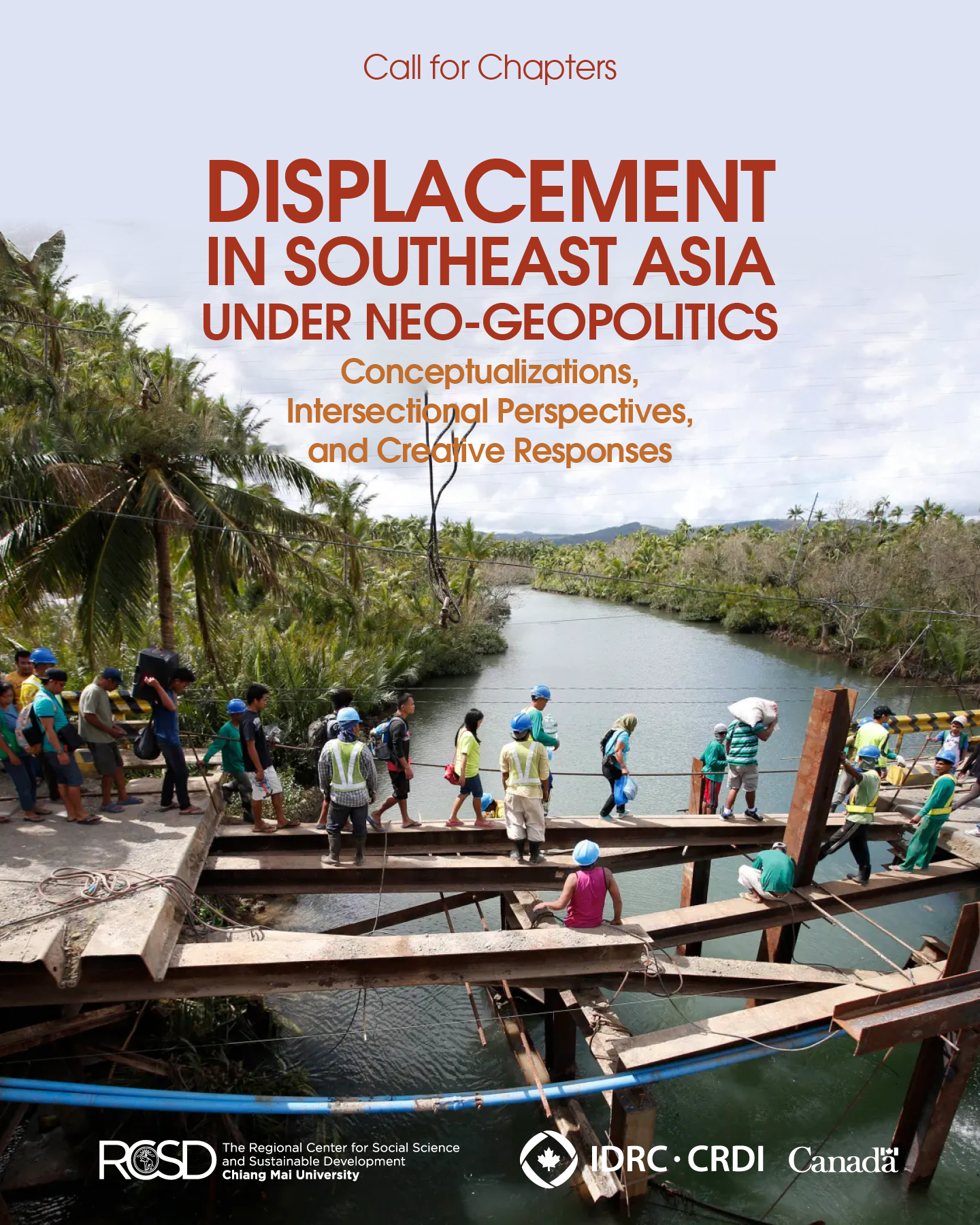
The Regional Center for Social Science and Sustainable Development (RCSD), Faculty of Social Sciences, Chiang Mai University, with support from International Development Research Centre (IDRC), under the Research Chair of Forced Displacement program invites chapter contributions for an edited scholarly volume titled “Displacement in Southeast Asia under Neo-geopolitics: Conceptualizations, Intersectional Perspectives, and Creative Responses.” The volume will be edited by Dr. Sirada Khemanitthathai, Chiang Mai University; Professor Dr. Paula Banerjee, Asian Institute of Technology and;
Associate Professor Dr. Carl Middleton, Chulalongkorn University. This volume aims to interrogate, expand, and critically examine how forced displacement is (re)framed and researched in Southeast Asia, seeking contributions that engage with emerging conceptual frameworks, intersectional perspectives, and creative responses.
Rationale and Framing
The field of forced migration studies is undergoing a conceptual transformation, with leading scholars advocating for “displacement” as a broader analytical framework that transcends traditional categories such as “refugee,” “migrant,” or “forced migrant.” This shift resonates with recent regional trends in Southeast Asia, where mobility, immobility, statelessness, climate-induced relocation, urban redevelopment, great-power rivalry, and colonial legacies are increasingly intertwined.
As Owen (2024) observes, “displacement” encompasses not only mobility across borders but also the complex spectrum of coercive disruptions to place and livelihood, resulting from historical, political, economic, and environmental forces. Ali Bhagat (2025), responding to Owen, urges scholars to recognize the capacity of displacement to reveal the systemic inequalities shaped by capitalism, race, gender, class, and colonial history, elements that are profoundly relevant in Southeast Asian contexts. Similarly, Diab (2025) advocates for intersectional and decolonial approaches, centering on lived experiences and agency, particularly in the aftermath of colonial dispossession and state management of migration. These perspectives prompt Southeast Asian scholarship to move beyond technical, state-centric framings and embrace critical, community-led, and justice-oriented responses.
Moreover, emerging geopolitical dynamics further reshape how displacement unfolds in Southeast Asia. China’s Belt and Road Initiative (BRI), presented as development-driven, has simultaneously produced widespread resettlements, dispossessions of indigenous communities, and ecological damage, for example by dam projects across Laos and Cambodia (Kirchherr et al., 2017; Middleton, 2022; Baird & Soukhaphon, 2024). These dynamics directly connect local displacement to global geopolitics, given that Beijing’s regional ambitions now rival U.S. strategic interests (Yu, 2017; Zha, 2023; Shambaugh, 2018). The resulting competition – which we term neo-geopolitics – and that also involves middle powers such as Japan, Europe, Thailand, and Vietnam, is reshaping Southeast Asia’s political economy, positioning displacement not only as a socio-economic problem but also as a geopolitical tool, often leaving local communities caught between powerful external forces (Gong, 2018; Calabrese & Cao, 2021).
Contemporary Context in Southeast Asia
Forced displacement in Southeast Asia has reached critical levels, driven by three primary factors, that often intersect with each other: armed conflict, climate disasters, and development projects. For example:
- Conflict-driven displacement: In Myanmar, protracted civil conflict has displaced approximately 3.5 million internally by 2025 (UNOCHA, 2024). These include the Rohingya, who have endured mass displacement due to persecution and statelessness, now living in exile in Bangladesh, and others spread across the region.
- Disaster-induced displacement: The Philippines alone recorded 5.7 million climate- and disaster-related displacements in 2021, primarily due to typhoons (Othering & Belonging Institute, UC Berkeley). Planned relocations in Vietnam and Indonesia are also underway to cope with recurring floods and storms (Soo-Chen and McKoy, 2023).
- Development-induced displacement: Dam construction, particularly in the Mekong region, has been a major driver. Laos’ Xayaburi Dam left resettled populations struggling with inadequate farmland and water access (Radio Free Asia, 2021), while the proposed Sanakham Dam could affect over 62,500 people in Laos and Thailand (Business & Human Rights Resource Center, 2024). Similarly, Cambodia’s Lower Sesan 2 Dam displaced over 5,000 indigenous residents (Fair Finance Asia, 2024; Manalansan, 2024), with projects like the Lower Srepok 3 threatening further communities, often without sufficient compensation (Fair Finance Asia, 2024; Soriththeavy, 2024).
These complex, layered and interlinked crises demonstrate how communities across Southeast Asia experience displacement in diverse ways that are simultaneously political, ecological, and intensely lived. Yet despite their significance, such issues remain under-examined within Southeast Asian scholarship.
Scope of the Edited Volume
This volume seeks contributions that:
- Advance conceptualizations of displacement attentive to Southeast Asian particularities, including the role of great-power geopolitics/ neo-geopolitics and associated infrastructure-led development in generating new forms of dislocation.
- Critique and complicate state-led categorization schemes, exploring how “refugee,” “migrant,” “Internally Displaced Person (IDP),” “stateless person,” or “development-induced displaced person” are produced, deployed, and challenged in regional policies, media, and law in Southeast Asia.
- Engage intersectionality and decolonial praxis, analyzing how overlapping systems of oppression rooted in race, ethnicity, gender, class, religion, and sexuality shape differentiated experiences of displacement.
- Examine displacement as a lived experience of neo-geopolitical contestation, particularly in relation to the Belt and Road Initiative and the U.S.-China strategic competition, mapping how local communities navigate, contest, or resist mega-developmental interventions and the shifting regional political economy.
- Interrogate place-making, survival, and reclaiming space, analyzing how displaced communities rebuild relational, cultural, and emotional ties in disrupted environments.
- Examine legal, ethical, and practical responses to displacement, evaluating the adequacy of international law, regional frameworks, state practices (including evacuations), human rights protections, and humanitarian interventions, and considering the risk of new forms of precarity and vulnerability in Southeast Asia.
- Reflect on methodologies: ethical challenges of researching communities affected by geopolitical projects and conflicts, participatory methods, and critical epistemologies in Southeast Asia.
- Explore solidarities, community resistances, and national/transnational networks advocating for justice and accountability in contexts of “displacement” in its various manifestations.
Submission Guidelines
Abstracts should outline the chapter’s focus, core argument and analytic perspective, use of Southeast Asian cases, and engagement with the existing conceptual and critical literature. Interdisciplinary approaches and collaborative (transdisciplinary) contributions are especially encouraged. Contributions may take the form of empirical studies, theoretical essays, methodological reflections, and/or policy critiques.
- Abstracts: 250–300 words, along with a short bio of contributor(s) up to 100 words
- Full Chapters: 6,000–8,000 words, including texts, footnotes, and references
- Key Dates:
- Abstract deadline: 31 October 2025
- Notification of acceptance: 1 December 2025
- Full chapter deadline: 25 February 2026
- Receiving comments from editors and external reviewers: 18 May 2026
- Revised chapter submission: 14 June 2026
- Publication: September 2026
Publishing
A book proposal, featuring a curated selection of accepted abstracts, will be submitted to a leading international academic publisher in late December 2025, which has a strong global distribution network and visibility in migration and Southeast Asian studies, ensuring a wide readership across academic, practitioner, and policy communities.
Contact and Submission Information
Submit abstracts and a short bio here:
Email inquiries to Dr. Andrew Wai Phyo Kyaw and Dr. Sirada Khemanitthathai, with Cc to office@rcsd-cmu.com