
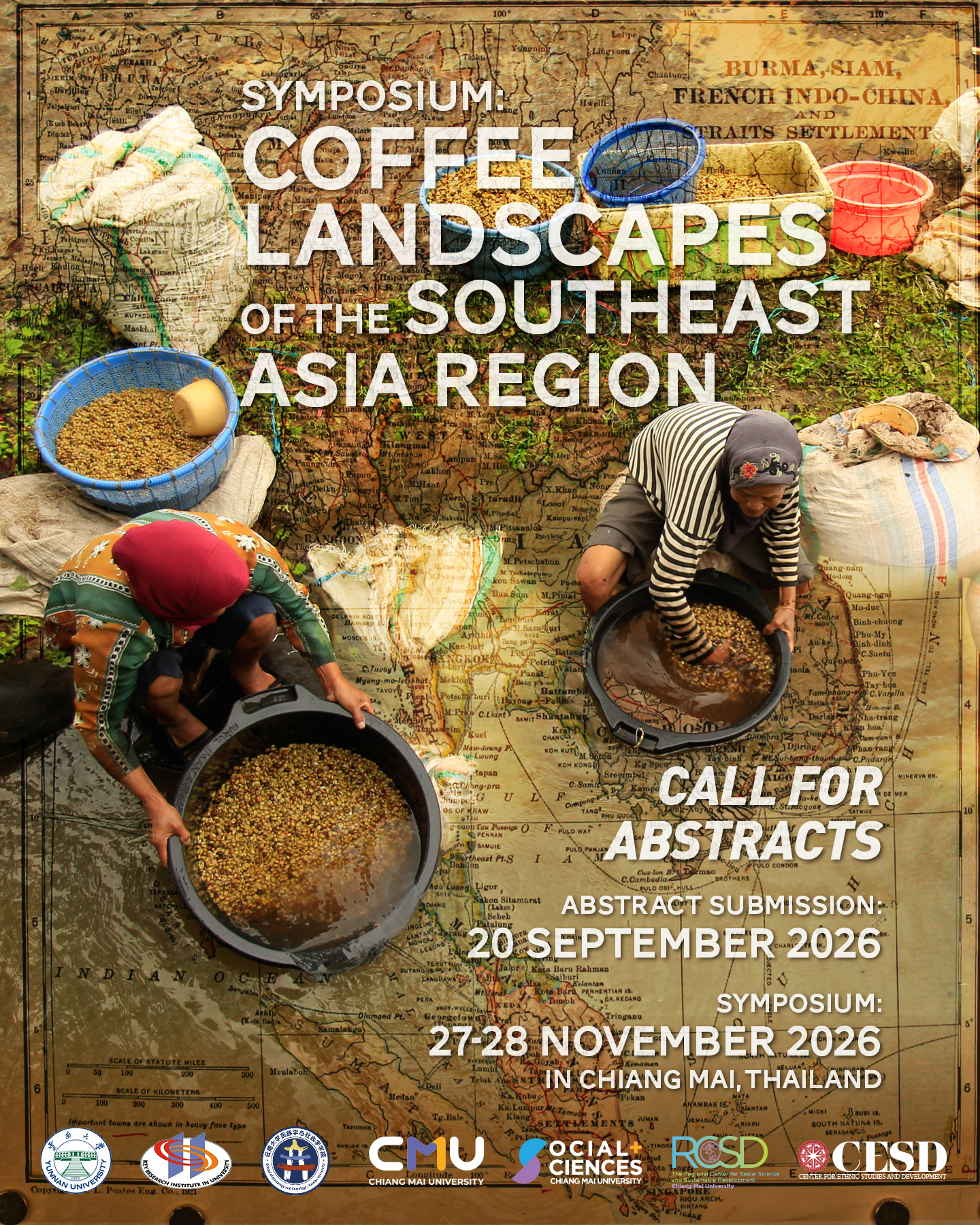
The Regional Center for Social Science and Sustainable Development (RCSD) and Center for Ethnic Studies and Development (CESD), Faculty of Social Sciences, Chiang Mai University, in partnership with The National Centre for Borderlands Ethnic Studies in Southwest China at Yunnan University is seeking paper submissions for “Constructing the Coffee Landscape in the Southeast Asia Region: Commodity, Culture, and Knowledge in Transition,” held from 27-28 November 2026 at Chiang Mai University, Thailand. For this third symposium on coffee hosted by the Centre, the focus will range over the broad Southeast Asian region, from the vast Indonesian archipelago to the mountainous frontiers of the Myanmar-Yunnan borderlands
The cultivation and production of coffee in Southeast Asia has grown from European colonial experiments of centuries past to a key export commodity and vital modern economic sector of many countries in the region. Coffee is deeply entangled with the development history of Southeast Asia, but its imprint on the region is highly uneven. Today, some Southeast Asian countries run legacy, large-scale, plantation-based coffee agriculture, while others have only begun experimenting with coffee cultivation and production as recently as the early 2000s. This diversity of histories, approaches, and values and meanings of coffee within the societies of the Southeast Asian region is fertile ground for the exchange of knowledge. Coffee, among the first of modern global commodities, is connected to high-value value chains of logistics and capital, with macro-level impacts on land, water and forest resources, and migration. However, coffee also remains stubbornly local, shaped by micro-level variations of climate, community, and geography. These diverse local contexts are also woven into coffee’s social and economic value.
Coffee is a major industry in Vietnam, Laos, and Indonesia, while in Thailand and China it has served as a mechanism of state-directed agricultural and rural development, with varying impacts on land, labor, agriculture, and local economies. In Myanmar and Cambodia, coffee remains a relatively new and promising, though still limited niche crop. Across these diverse political, social, and economic national contexts, agronomists, farmers, and entrepreneurs confront challenges common to coffee production worldwide: access to land and markets, ecosystems and sustainability, knowledge of cultivation and processing, and the intensifying effects of climate change on yields and livelihoods. At the same time, coffee functions as both consumer commodity and cultural phenomenon in the core urban societies of the region, generating new trajectories of value. From climate-affected production landscapes to rapidly evolving coffee culture, the “social life” of coffee reflects and amplifies broader divisions of gender, ethnicity, class, and the urban–rural divide.
This symposium offers the opportunity to explore the multiple realities of coffee—as agricultural commodity, cultural phenomenon, and social nexus—in the Southeast Asian region at an historical moment where globalization and free, connected markets are no longer assumed givens, and the impacts of changing climate are increasingly felt and lived. The goal for this event is to bring together academics and practitioners to exchange ideas, research, and practice-based knowledge. Symposium participants will engage with coffee in a multiplicity of approaches, examining its material and social legacies and imagining future possibilities for coffee’s place in the economies and societies of the region.
We invite scholars, coffee growers and producers, development practitioners, and coffee entrepreneurs across the Southeast Asian region to submit abstracts for individual or panel presentations, poster presentations, or roundtable discussions. This will be a forum for not just academic presentations, but also discussion with entrepreneurs, growers, and community-based practitioners to exchange and share experiences, knowledge, and points of view.
Key Themes
- Southeast Asia coffee history: coffee’s colonial and missionary legacy in the region; coffee, frontiers and the nation-state; history of the development of production and coffee in the diverse contexts of SEA and the wider region;
- Coffee agriculture and agroforestry under climate change: Species and varieties of coffee cultivars; cultivation, land and resource use; technologies of coffee; climate change and new vulnerabilities; productivity, resilience, and livelihood; coffee agroforestry, carbon and sustainability
- Coffee as commodity: coffee, industrialization and globalization; capital, finance, logistics, and infrastructure in the coffee economy; coffee and the tourist economy; markets, networks and the urban/rural divide
- Coffee culture: coffee as “invented tradition”; the social space and relations of coffee consumption; coffee and ethnicity: branding, image and taste; coffee transformations: mass, specialty, third-wave, and beyond
- Coffee in agrarian transition: land rights and resource conflicts; coffee’s role in development and modernization; gender and ethnicity in coffee production and the market; coffee, migration, and labor
- Coffee and knowledge production: Coffee entrepreneurs, information and market; innovation and technical development; sensory knowledge: taste, aroma, cupping, and look; new skills and occupations: roasters, graders, baristas
Structure
The Symposium will consist of both academic and experiential components. The academic program will include paper presentations, panel discussions, and roundtable sessions. The symposium will also feature exhibitions, workshops (such as hands-on coffee experiences like roasting, cupping, aroma evaluation, and tasting).
Timeline
- Deadline for abstract submission: 20 September 2026
- Deadline for paper submission: 31 October 2026
- Deadline Registration for conference participants: 10 November 2026
- Coffee Symposium: 27-28 November 2026
Abstract Submission Process
- Individual/Joint paper – Abstract of not more than 300 words
- Roundtable – Abstract of not more than 500 words
- Submit your abstracts and register here
Contact: RCSD Secretariat, office@rcsd-cmu.com