
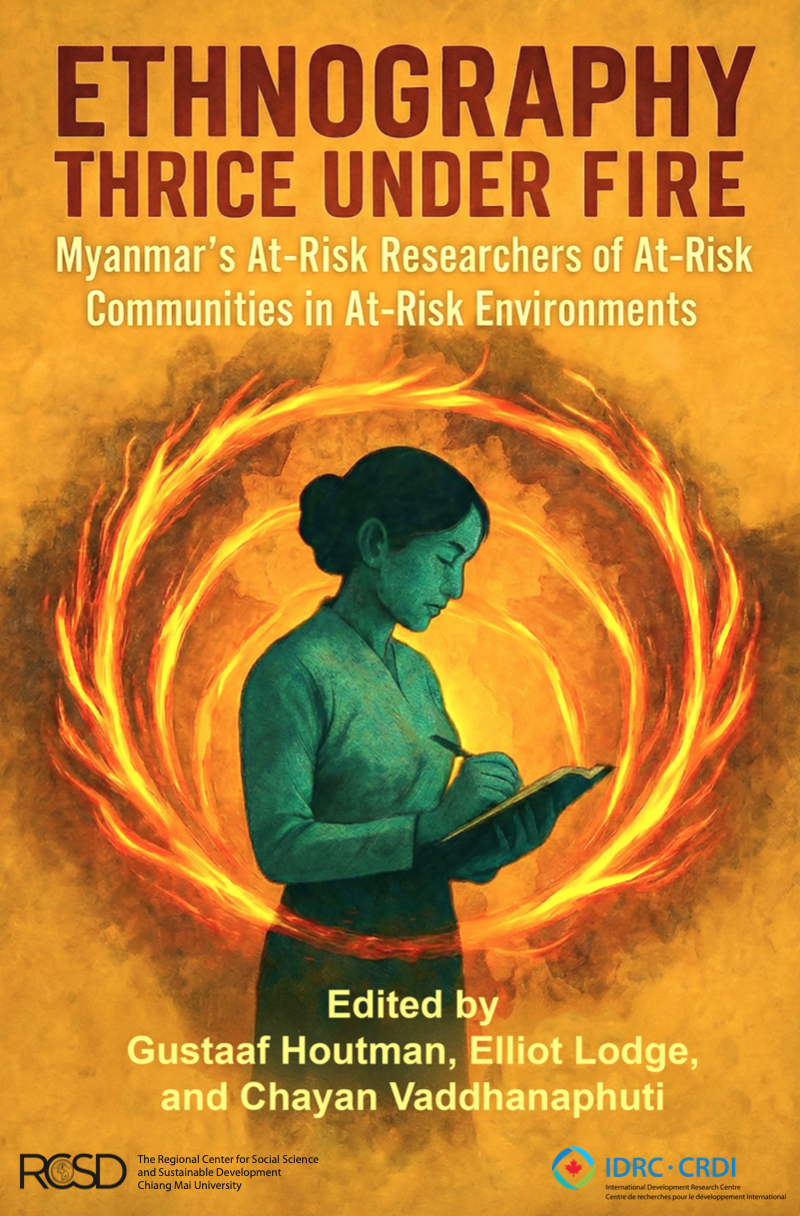
Gustaaf Houtman, Elliot Lodge, and Chayan Vaddhanaphuti, editors
What happens when ethnographers join the resistance movement they study, their communities face systematic erasure, and universities are weaponized against them? This volume compiles the research of ten Myanmar academics who joined the Civil Disobedience Movement (CDM) following the 2021 military coup and have continued conducting fieldwork under conditions of extreme danger. As CDM participants studying communities under attack while working without institutional support, these scholars embody what the editors term the “thrice under fire” condition: researchers under fire, communities under fire, environments under fire.
This triple threat transforms how knowledge is made. When researcher and researched share the same vulnerabilities, lived experience generates insights that detached observation cannot. When communities face deliberate erasure, archiving becomes an act of preservation. When academic infrastructure collapses, methods adapt through necessity. The volume identifies three innovations emerging from this convergence. These include experiential validity, preservation epistemology, and resilient methodology. Together, these produce what the editors term “solidarity knowledge” This understanding is forged through shared risk.
The ten contributors have revolutionized fieldwork under siege–and their findings are equally groundbreaking. Chapters document forms of everyday resistance in besieged communities, women’s moral authority emerging from crisis, digital commons built by exiles in Thailand, social capital transformations in liberated villages, gendered resilience among the displaced, and Myanmar Muslim identity in the Spring Revolution. Each demonstrates how constraint becomes generative in ethnographic research.
This is scholarship that refuses erasure. These researchers prove that intellectual work becomes most vital when most threatened, pursuing questions that matter even when thrice under fire.
Essential reading for ethnographers, human rights advocates, Myanmar scholars, and anyone concerned with the future of knowledge production under authoritarian rule
- THEME